My Christmas Letter
December 23, 2025
As I said, having a sense of humor will get you in trouble nowadays, and this whole thing would be funny if I wasn't in leg-irons.
Thank you, Chris T. ($70), for your monumentally generous subscription
to this site -- I am greatly honored by your support and readership.
Thank you, ProBono ($7/month), for your marvelously generous subscription
to this site -- I am greatly honored by your support and readership.
Thank you, Joe C. ($70) for your superbly generous subscription
to this site -- I am greatly honored by your support and readership.
Thank you, banka ($7/month) for your splendidly generous subscription
to this site -- I am greatly honored by your support and readership.
Dear friends and family:
I'm writing this Christmas missive while my court-appointed lawyer trades cryptocurrencies on his phone. He was recently laid off by an investment bank and since he's never been in court and has zero criminal justice experience, I expect my future missives will be postmarked Alligator Alcatraz.
I'm in a bit of a pickle at the moment, as I was arrested near the Canadian border while attempting to beat the high tariff fees by sneaking a load of lumber across the border via an old logging road. Apparently a drone spotted me. Since it was still dark, maybe they have infrared cameras on the drones now, who knows.
I might have skated through that bust except they ran some kind of scan on me and concluded I was a domestic terrorist. I know having a sense of humor will get you in trouble nowadays, but does my "Yoda for President" bumper sticker make me a terrorist?
They seemed to take an uncommon interest in the Grateful Dead logo on my rear window, and since the Dead have fallen out of the culture's meme-scape, maybe they reckoned that was some secret membership sign or something.
I guess I didn't do myself any favors when the interrogation started, because after a while I said, "If I had a wooden leg, would that make me a table?"
Apparently my lack of online activity raised a red flag, and my explanation that I'd been banned from every Big Tech platform only stoked their suspicion. I always joked that I should watch more videos of puppies and kittens to blend in some, and I guess that's not far off the mark. If I'd viewed more videos of puppies and kittens, I might be a free man right now instead of a suspected terrorist heading for Alligator Alcatraz.
After I told the interrogator to put it where the sun doesn't shine, they rigged up some AI interrogation gizmo. The male voice asked me questions, and I spun out a tall tale that yes, I was intent on bringing down the status quo with my truck and a load of lumber, and maybe the AI chatbot would like to guess how this fit into my compadres' grand plan.
It did its sympathetic therapist number on me but I didn't bite, and I threw all sorts of wacky clues about the real plan at it. When it started asking me about the connection between Hannah Arendt, The Little Prince and Sugar Frosted Flakes, I reckoned it was either hallucinating or working on some mirror-universe thing that was way above my pay grade.
As you know, I am often my own worst enemy, and my last clue to the AI chatbot interrogator was to mention that the whole terrorist plot was based on protecting our precious bodily fluids, and investigators should ask to speak with Colonel Batguano.
As I said, having a sense of humor will get you in trouble nowadays, and this whole thing would be funny if I wasn't in leg-irons. Anyway, put a Grateful Dead skull or a Dancing Bears bumper sticker on your vehicle, if you dare.

Because yes, if you have a wooden leg, you will be taken for a table.
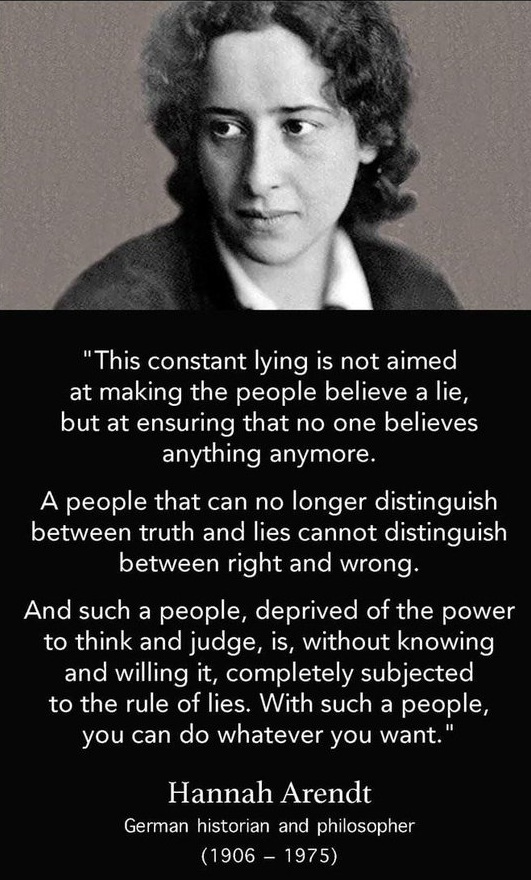
It turns out this quote is a paraphrase, not an actual quote:
The closest in spirit and content, and also the most easily available, is from an interview with Roger Errera in 1973, what turned out to be Hannah Arendt's last public interview. Arendt spoke about the importance of a free press in an era of mass manipulation of truth and public lying: She said:
"The moment we no longer have a free press, anything can happen. What makes it possible for a totalitarian or any other dictatorship to rule is that people are not informed; how can you have an opinion if you are not informed? If everybody always lies to you, the consequence is not that you believe the lies, but rather that nobody believes anything any longer. This is because lies, by their very nature, have to be changed, and a lying government has constantly to rewrite its own history. On the receiving end you get not only one lie--a lie which you could go on for the rest of your days--but you get a great number of lies, depending on how the political wind blows. And a people that no longer can believe anything cannot make up its mind. It is deprived not only of its capacity to act but also of its capacity to think and to judge. And with such a people you can then do what you please."
The key point in Arendt's statement is that as lies multiply, the result is not that the lie is believed but that people lose faith in the truth and are increasingly susceptible to believe anything. When cynicism about truth reigns, lies operate not because they replace reality but because they make reality wobble--a phrase Arendt employs in her essay Truth and Politics. In that essay, Arendt argued that mass lying undermines our sense of reality by which we find our bearings in the real world:
"The result of a consistent and total substitution of lies for factual truth is not that the lie will now be accepted as truth and truth be defamed as a lie, but that the sense by which we take our bearings in the real world--and the category of truth versus falsehood is among the mental means to this end--is being destroyed."
The Arendtian point is that constant lying by a propaganda machine does not lead to the lie being believed but leads, instead, to cynicism. This is an argument that Arendt made, already, in her first published book The Origins of Totalitarianism. In that book, Arendt writes:
"Mass propaganda discovered that its audience was ready at all times to believe the worst, no matter how absurd, and did not particularly object to being deceived because it held every statement to be a lie anyhow. The totalitarian mass leaders based their propaganda on the correct psychological assumption that, under such conditions, one could make people believe the most fantastic statements one day, and trust that if the next day they were given irrefutable proof of their falsehood, they would take refuge in cynicism; instead of deserting the leaders who had lied to them, they would protest that they had known all along that the statement was a lie and would admire the leaders for their superior tactical cleverness."
New Podcasts:
Insane Financial Imbalances and a Social Revolution (36:34 min)
Ultra-Processed Life: Unhealthy, Addictive, Deranging, Artificial (36 min)
My new book Investing In Revolution is available at a 10% discount ($18 for the paperback, $24 for the hardcover and $8.95 for the ebook edition).
Introduction (free)
Check out my updated Books and Films.
Become
a $3/month patron of my work via patreon.com
Subscribe to my Substack for free
NOTE: Contributions/subscriptions are acknowledged in the order received. Your name and email
remain confidential and will not be given to any other individual, company or agency.