Insane Financial Imbalances and Social Revolution
December 19, 2025
A rebalancing of the economy and society will ultimately prove very positive, but first we must navigate the model collapse of insane financial extremes.
Thank you, Melissa G. ($70), for your monumentally generous subscription
to this site -- I am greatly honored by your support and readership.
Thank you, Rey R. ($7/month), for your marvelously generous subscription
to this site -- I am greatly honored by your support and readership.
Thank you, BioChamp ($70) for your superbly generous subscription
to this site -- I am greatly honored by your support and readership.
Thank you, Mike H. ($70), for your splendidly generous subscription
to this site -- I am greatly honored by your support and readership.
I've endeavored to explain how self-referential models veer into hallucinations that are accepted as accurate reflections of the real world. Models are by definition synthetic abstractions of the real world, and as these "train" on their own output, they drift away from authentic understanding without the users being aware that their "world" is both artificial and self-reinforcing: each iteration reinforces their belief in the model's accuracy.
Patient users of AI programs can force AI to admit its output was a hallucination, at which point AI tends to abjectly apologize. But human pride--especially strong among those with high opinions of their intelligence and mastery of life--precludes recognition of catastrophic error (i.e. believing in a hallucination) and apologizing for the error.
Human hubris leads us to double-down when faced with evidence we've placed our faith in a hallucination. We deny that our system/model is a self-reinforcing hallucination even as we go over the falls. The faint cries of "save me!" are short-lived.
Models collapse from their own internal dynamics. They don't need our approval. Our disapproval doesn't stop their collapse. Our choices boil down to 1) go over the falls as models collapse; 2) snap out of the hallucination or 3) enter the netherworld of hyper-normalization, the state of mind where we embrace two contradictory "truths": the hallucination is forever and we're not surprised when it collapses.
Model collapse manifests in many ways: people and systems break down. Anti-social behaviors become normalized, and extremes are accepted as normal as we habituate to dysfunction and breakdowns.
I call this Anti-Progress: what we're sold as "progress" actually reduces our quality of life. In my book The Mythology of Progress, I describe Progress as a powerful mythology, but it can also be understood as a model that is collapsing into a hallucination we cling to with hubristic tenacity.
In everyday life, these extremes manifest as
Ultra-Processed Life, a synthetic world in which artificial substitutes have replaced authentic life and experiences because the model increases profits via unhealthy addictions in both the consumer and digital realms.
But people break down in this Mouse Utopia of ultra-processed abundance, and the model's self-reinforcing iterations veer ever farther from authentic experiences.
Which brings us to my latest podcast with Richard Bonugli,
Insane Financial Imbalances and a Social Revolution (36:34 min). The word "insane" is jarring, for the dominant model of the global order holds that financial extremes are not just sane, they're proof that all is well, and so calling these extremes "insane" is what's insane.
This is classic model collapse: up until the point of breakdown, the model seems to be functioning perfectly, because being self-referential, there is no other possible output other than the system is performing nominally.
In my new book Investing In Revolution, I describe the two structural flaws in the current model: 1) due to its success in generating abundance, the model's adaptive capacity has decayed, leaving it incapable of adapting to rapidly changing real-world conditions, and 2) the dominance of the financial model has fatally imbalanced society and the economy, an extreme imbalance that will be rebalanced by the pendulum swinging to the opposite extreme.
I call this systemically predictable rebalancing a social revolution, as meet the new boss, same as the old boss is no longer sufficient: the values and incentives that maintain a sustainable balance between society and the economy must change. This Reformation is not financial or political, it is fundamentally social in nature.
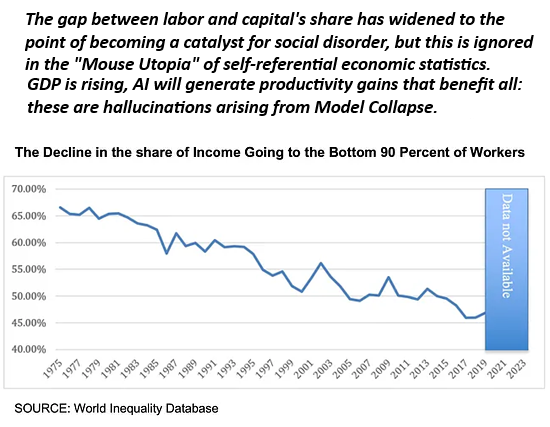
This imbalance is visible in the widening divide between the share of the economy going to labor and capital: wage earners' share has been declining for decades, reducing their capacity to afford a secure quality of life without piling up debt:
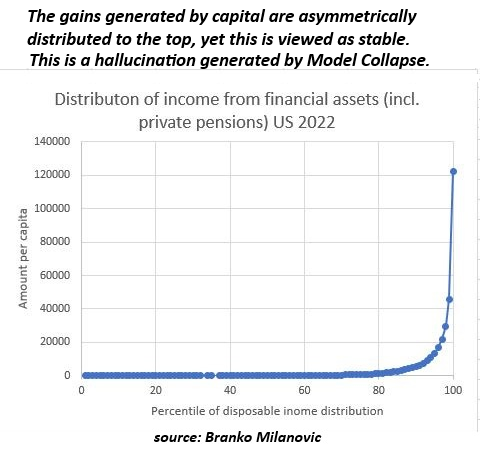
The earnings generated by ownership of capital go mostly to the very top of the wealth-power pyramid: the majority of income from capital flows to the top 0.25%, with the rest dribbling down to the top 5%.
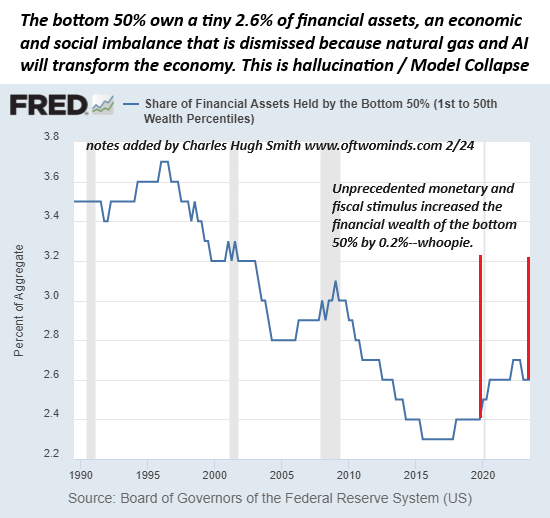
The bottom 50%'s share of financial assets amounts to signal noise--2.6%.
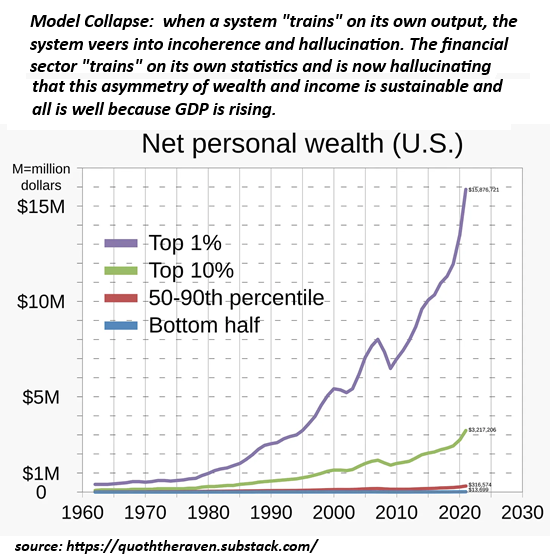
This imbalance is so extreme that it will catalyze social disorder, yet to call it unsustainable is "insane."
The health of the non-elites has reached crisis levels, yet this too is unremarkable because the model has a "solution": more costly medications that must be taken for life: highly profitable, so all is well.
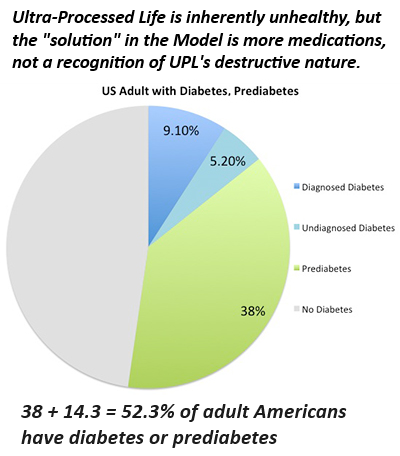
The hallucination that this is all wonderfully sustainable reveals the dominance of the financial model of how the world works. That society is breaking down is of no concern because natural gas is so abundant that we can easily power up AI data centers, and GDP is rising.
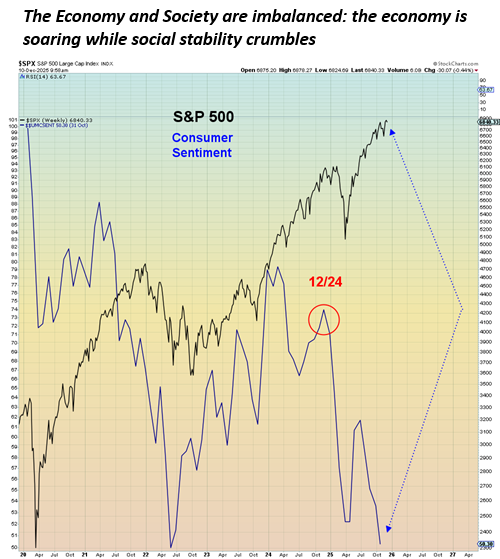
The problem is we only manage what we measure, and all the financial analysis "trains" on its own output. Those staring at screens of soaring stocks and corporate profits declare this is the best possible world while the social order breaks down around them.
A rebalancing of the economy and society will ultimately prove very positive, but first we must navigate the model collapse of insane financial extremes, extremes that are unrecognized in the current hallucination. The collision of the self-reinforcing hallucination with the real world will be challenging.
If we accept that the dominant models have lost their capacity to adapt, and that the imbalance between economic forces and society have reached extremes that demand rebalancing, we can return to the real world in good order. If we cling to the hallucination, then over the falls we will go.
New Podcasts:
Insane Financial Imbalances and a Social Revolution (36:34 min)
Ultra-Processed Life: Unhealthy, Addictive, Deranging, Artificial (36 min)
My new book Investing In Revolution is available at a 10% discount ($18 for the paperback, $24 for the hardcover and $8.95 for the ebook edition).
Introduction (free)
Check out my updated Books and Films.
Become
a $3/month patron of my work via patreon.com
Subscribe to my Substack for free
NOTE: Contributions/subscriptions are acknowledged in the order received. Your name and email
remain confidential and will not be given to any other individual, company or agency.