Lessons from China's Cultural Revolution
January 21, 2026
Just as nobody foresaw the Cultural Revolution, few if any foresee the emergence of the American equivalent.
Thank you, Richard H. ($70), for your monumentally generous subscription
to this site -- I am greatly honored by your support and readership.
Thank you, NoHo ($70), for your magnificently generous subscription
to this site -- I am greatly honored by your support and readership.
Thank you, Craig W. ($70) for your superbly generous subscription
to this site -- I am greatly honored by your support and readership.
Thank you, JS ($7/month) for your splendidly generous subscription
to this site -- I am greatly honored by your support and readership.
China's Cultural Revolution (1966-1976) is interesting on multiple levels. The conventional narrative holds that it was the result of a power struggle between Mao and competing elements in the Chinese Communist Party (CCP), as Mao launched a chaotic cleansing of the Party's leadership that soon devolved into widespread disorder that consumed much and yielded little of lasting value.
My understanding of the Cultural Revolution comes not just from academic studies but from first-hand accounts from friends who lived through it. There are two stipulations in this account:
1. The Cultural Revolution remains politically sensitive, as it was clearly a catastrophe for China that reflects poorly on various sacrosanct figures and institutions. Discussions of what happened are not welcomed, and so even when those who lived through it are in the safety of their own home in the US, they tend to speak in hushed tones, for the topic is verboten.
2. As a general rule, Asian cultures do not relish badmouthing their nation or culture. Westerners will not be offered honest accounts unless they are longtime friends who have demonstrated their trustworthiness over many years. So "friends" who are actually only acquaintances are not going to speak openly.
The travails of senior officials are well-known. A recent book documents the experiences of Xi Jinping's father, a high-ranking CCP official who--along with his son--suffered greatly in the Cultural revolution: The Party's Interests Come First: The Life of Xi Zhongxun, Father of Xi Jinping details the difficulties faced by loyalists in surviving Mao's mercurial purges and precipitous humiliations of senior officials.
It doesn't take much armchair psychoanalyzing to discern the enormous impact the Cultural Revolution had on Xi Jinping's worldview, mindset, goals and priorities.
Equally obvious is how events quickly spiraled out of control, reaching extremes far beyond what was initially anticipated. The public's passive compliance to authority and narrative control was taken to be permanent. Passive compliance appears permanent but it is always contingent.
Firsthand accounts of regular people have typically received a lower profile. One friend's father was an officer in the People's Liberation Army (PLA) which we might have presumed was immune to the chaos. But PLA officers were demoted, put under house arrest and humiliated, while many of those associated with someone deemed an enemy of the people were sent down to the countryside even if they were innocent of wrongdoing.
Another friend's father was put under house arrest for years for the "crime" of having traveled to Soviet Bloc countries as an acrobat in a performing troupe.
In other words, the Cultural Revolution opened the door to denouncing, humiliating, torturing and even killing not actual "class enemies," but loyal Party members who were "guilty" of nothing more than performing their assigned duties. The Cultural Revolution gave permission to pursue personal vendettas and exact retribution on an unimaginably vast scale.
A friend born in 1967 at the height of the initial tumult was named "Love Mao" as a means of fitting in and inoculating the family from the sort of baseless denunciations that were not just permitted but encouraged as "revolutionary activity."
What few if any commentators mention is the unrecognized pent-up frustrations with a system that was launched with such promise and delivered less than what was promised. "Let a hundred flowers blossom, let a hundred schools of thought contend" turned into The Great Leap Forward, a disastrous policy that led to famine.
The unstated context of the Cultural Revolution was poverty. Another friend described how scarce and precious eggs were: her parents carefully divided the occasional egg into four pieces, one for each family member.
People did not have to be coerced to join the Red Guard's rampages; they relished the opportunity to be free of any cultural or political constraints. It's tempting to dismiss this as just another example of the madness of crowds, but this ignores the underlying dynamic of expectations not being met and the consequences of repression and never-ending power struggles and purges.
The first lesson of the Cultural Revolution is that if redress is unavailable, then retribution will become the default pathway. I discuss these dynamics in my new book Investing In Revolution in the context of their inevitability in the current era.
The second lesson of the Cultural Revolution is that allowing--much less encouraging--the unleashing of frustrations with the system on ill-defined "enemies of the people" who are innocent quickly spirals out of control. In the Cultural Revolution, the targets quickly expanded from those in authority positions in the Party to anyone deemed suspicious for any number of reasons: being educated, having traveled to other countries, being the offspring of the landlord class, being the offspring of a purged official (like Xi Jinping being abused because his father had fallen from grace), or simply being an object of envy.
This expanding circle soon included cultural relics of the past, and so irreplaceable Buddhist temples and other priceless artifacts were destroyed out of "revolutionary fervor."
The third lesson of the Cultural Revolution is that once these forces are released, it is impossible to put them back in the bottle. Those in power reckon that unleashing a flood tide of resentments and frustrations with the system on a selected group of scapegoats relieves the potential risk of the public revolting against the regime.
But this ignores the potential for the injustice and chaos to destabilize the regime, for the injustice and destruction don't just affect the scapegoats; they undermine the social, economic and political orders, too.
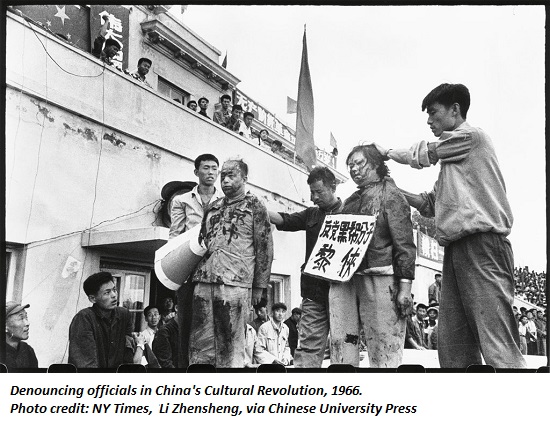
Just as nobody foresaw the Cultural Revolution, few if any foresee the emergence of the American equivalent. The consequences of expectations not being met build up despite repression and narrative control, and when the containment finally bursts, the dynamics are nonlinear--chaotic, unpredictable, uncontrollable.
Everything is forever until something unexpected breaks.
My new book Investing In Revolution is available at a 10% discount ($18 for the paperback, $24 for the hardcover and $8.95 for the ebook edition).
Introduction (free)
Check out my updated Books and Films.
Become
a $3/month patron of my work via patreon.com
Subscribe to my Substack for free
NOTE: Contributions/subscriptions are acknowledged in the order received. Your name and email
remain confidential and will not be given to any other individual, company or agency.