The US Economy in a Nutshell: A Few Winners, Everyone Else Loses Ground
January 29, 2026
Maybe this arrangement isn't as stable and sustainable as the winners imagine.
Thank you, David K. ($300), for your beyond outrageously generous subscription
to this site -- I am greatly honored by your support and readership.
Thank you, Jamshyd H. ($50), for your magnificently generous subscription
to this site -- I am greatly honored by your support and readership.
Thank you, John D. ($200) for your beyond outrageously generous subscription
to this site -- I am greatly honored by your support and readership.
Thank you, Colin G. ($70) for your splendidly generous subscription
to this site -- I am greatly honored by your support and readership.
Here's the US economy in a nutshell: corporate/state concentrations of financial, market and political power are the winners, and everyone outside these fortresses is losing ground. The Wall Street Journal is generally viewed as pro-business, and so it's particularly striking when the WSJ published this:
The Economic Divide Between Big and Small Companies Is Growing: Economic fortunes of low- and high-income Americans are diverging--same pattern happening with companies. (WSJ.com)
--The growing divide between the fortunes of small and large businesses mirrors the divide that has emerged over the past year between low-income Americans and their high-income counterparts.
--Large, publicly traded companies in the S&P 500 saw net income increase by 12.9% in the third quarter, contrasting with faltering small-business profits.
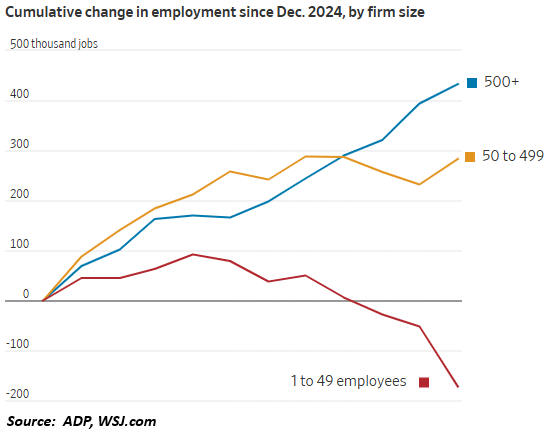
--Small businesses are facing economic headwinds, including high inflation and cautious consumers, leading to job cuts; 120,000 jobs were shed in November.
In other words, the small circle of winners and the larger circle of those losing ground describes both households and enterprises: small businesses--lacking the concentrated financial / political power to exercise monopoly-cartel control of their market and protect their fiefdom by buying political influence--are in steep decline--and this is in "good times," i.e. the economy is expanding, not contracting in a recession.
As in the household sector, the winners are doing splendidly while everyone else loses ground. The media--controlled by the winners, of course--tout the winners as if they're the norm rather than the outliers in a winner take most economy.
The quasi-monopolies and cartels of Corporate America reign supreme: trillion-dollar valuations, soaring profits, unmatched political and market control. Small business, whose interests are diffuse and widely distributed, are reduced to tax donkeys struggling to pay soaring rent, wages, utilities and overhead costs without the market muscle of monopolies / cartels to force consumers to pay higher prices for degraded goods and services.
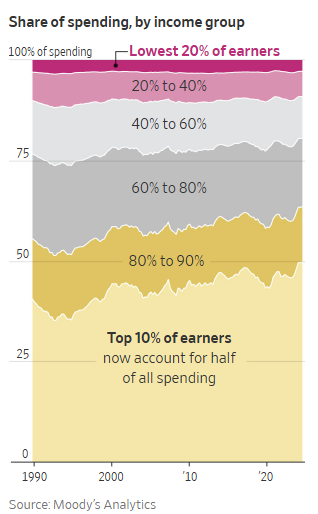
The top 10% of households are also doing extremely well, accounting for fully half of all consumer spending as their earnings, passive investment income and assets all bubble higher.
A few of these top earning households are blue-collar households with workers earning top pay due to scarcity of their skillsets, but most are working in the state / corporate sectors with the power to pay high wages and benefits regardless of what's happening to the bottom 90%.
While large corporations are adding employees, small businesses are shedding employees to survive.
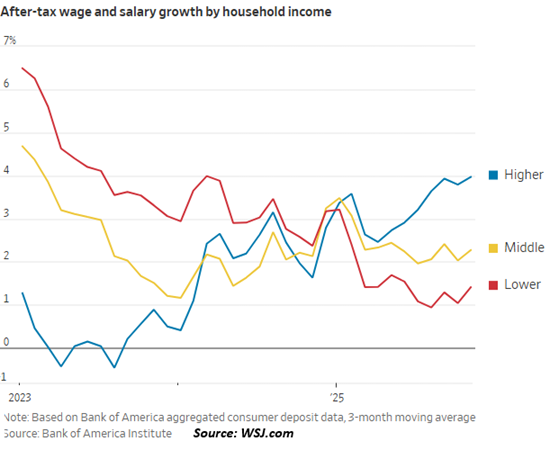
Wage growth mirrors this asymmetric distribution: the post-pandemic stimulus trillions that boosted the mid and lower income workforce has reversed while wages for the top tier are rising.
The point here is that entities with financial, market and political power don't need a thriving bottom 90% to increase their dominance. They have no real need to care what's happening to the bottom 90%, as they can extract higher taxes, rents, subscriptions and prices while degrading the goods and services they provide because an economy dominated by monopolies and cartels is a TINA Economy: there is no alternative, as the world outside the monopolies and cartels is a barren landscape stripped of the functionality required to participate in the economy.
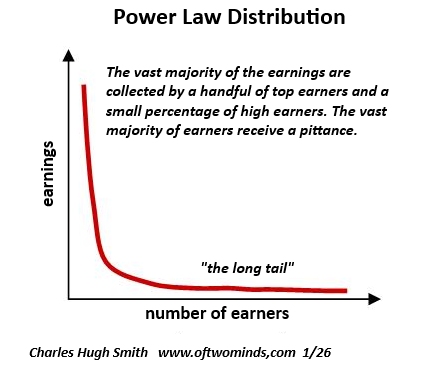
We're constantly assured an economy where the gains follow an extraordinarily asymmetric power-law distribution is a wondrous engine of sustainable growth that benefits everyone, but the facts don't support this fairy-tale PR promoted by the winners to placate those losing ground.
Maybe this arrangement isn't as stable and sustainable as the winners imagine.
My new book Investing In Revolution is available at a 10% discount ($18 for the paperback, $24 for the hardcover and $8.95 for the ebook edition).
Introduction (free)
Check out my updated Books and Films.
Become
a $3/month patron of my work via patreon.com
Subscribe to my Substack for free
NOTE: Contributions/subscriptions are acknowledged in the order received. Your name and email
remain confidential and will not be given to any other individual, company or agency.