When Predictability Collapses, What's Scarce and Valuable Is Adaptability
May 2026
The irony in becoming more adaptable is that it's the opposite of "success."
Insight comes in three flavors. The first adds to our knowledge and enjoyment of life. To paraphrase Bertrand Russell, our knowledge of where the peach tree originated adds to our enjoyment of the peach.
The second flavor manifests in the realm of abstractions, aiding our understanding of complex systems and intellectual constructs. These insights can be intellectually satisfying, but they offer no selective advantage in terms of improving our adaptive capacity to make decisions that launch decisive actions that change our lives. They're akin to solving an intellectual puzzle: satisfying but they don't change our inner life or real-world behaviors.
The third flavor of insight changes us and the trajectory of our lives. We understand something fundamental about ourselves and our own lives that forces us to change. We cannot go back, we can only pretend nothing has changed within us. But the truth cannot be extinguished by pretense, and eventually it catalyzes dramatic changes in the trajectory of our lives. The insight is invisible, but it leads to decisions that change how we respond to ourselves and to the real world.
This question illuminates the difference between the third flavor of insight and the others: is this actionable? In other words, does this insight force me to change either my response to myself, or my real-world life, or both?
For example: is our high-energy-consumption status quo way of life sustainable? How do we "fix the world by fixing money"? We can discuss these forever but very few of us will dramatically change our lives as a result of reading the pros and cons in endless scrolls of posts and essays. It simply isn't actionable, even if we claim it is.
This third flavor of insight is what interests me, and it's what I write about, either directly or indirectly. I am interested in systems and constructs not as abstractions but as actionable insights that lead us not just to a new understanding but to concrete action in our own lives that transform our real-world adaptability.
Adapt or die sound overly dramatic, but it is the foundation of all life.
We may pride ourselves on our adaptability, but we're all prisoners of human nature, our own genetic / epigenetic character and our experience. As humans, we favor both novelty and stability--"safe" novelty that enlivens our stable, secure life. If we do something daring, we expect the system to save us, because that's been our experience.
Our experience is limited, and so it shapes the boundary conditions of our adaptability. Beyond these boundaries, we no longer have any previous experience to guide us. Our OODA loop--observe, orient, decide, act--has little experience to inform each step of the loop. When faced with a fast-moving novel situation, we become disoriented, overwhelmed, distracted, confused. This is not ideal in terms of making productive decisions and taking productive actions.
The wider our experience, the wider our boundaries / constraints. Intense experiences tend to push our boundaries out. A famous filmmaker once noted that he learned more about filmmaking in two months as director Roger Corman's assistant than he did in two years of film school.
I often refer to Mike Tyson's observation that "everyone has a plan until they get punched in the mouth" because this is an excellent way to describe the boundaries of everyday experience. My observation is that relatively few people have ever been grabbed, knocked down, etc., and so they're unprepared to respond. The same is true of losing control of a vehicle, slipping off a roof, or other fast-moving real-world situations that get inside our OODA loop, meaning we don't have time to observe or orient, much less decide and act. At best we respond instinctively.
As a general rule, we don't think anything unpredictable can happen because our experience is everyday life is stable and predictable. Our boundary conditions are a tight circle around us.
Having experienced being disoriented, overwhelmed, distracted and confused is itself a highly valuable learning experience, as it's only in such situations do we become aware of the limits of our experience.
We can't unlearn our experience, and this is what makes it so valuable. But it also establishes a boundary beyond which we're unprepared.
The more times we've been pushed to our limits, the more aware we are of how far our boundaries extend. By being pushed to our limits, I mean our internal psychological / emotional limits, our physical limits, our financial limits, our cognitive limits.
In being pushed to our limits, we're forced to deal with edge / boundary conditions that are unclear and ambiguous yet demand a response. We experiment, and this is the "loop" in the OODA loop: we're keenly alert to the feedback of our decisions and actions--are we going in the right direction or not?
We quickly come to appreciate buffers and backups, so if we make a bad move we can still recover. We come to appreciate diversifying our response, so we're not putting all our eggs in one basket.
The experience of getting knocked down, of things going against us, of a decision being wrong--these inform our response not just to a repeat of a particular challenge but to all novel challenges, as the more often we're pushed beyond the boundaries of our previous experience, the more experience we gain in being adaptable.
Since we favor stability, we seek a simple solution that puts the problem to bed: a straightforward decision that we can act on without pushing beyond our boundaries.
In other words, becoming more adaptable is itself the most valuable experience, but it's one we shy away from precisely because it makes us uncomfortable by challenging our expectations and simplistic solutions.
We avoid risk for good reason: the higher the risk, the more likely the result will be failure. But failure is the intense experience that pushes our boundaries out and increases our experience of adaptability. We seek success, but if we take on risk we will inevitably experience failure, and we will then be forced to loop the feedback of failure into our follow-on response. This builds the "muscle" of adaptability.
When pushed to our limits, we become keenly aware of the value of buffers, backups, a safety rope or tool within reach. We also become keenly aware that bad things can happen, and our initial response might fail, demanding a quick correction or different response altogether.
The American culture--and other cultures, too--encourages a no-limits everyone can achieve their dreams if they work hard enough positivity, and this has its benefits. But to the degree it denigrates our awareness that bad things can happen--dismissed as doom and gloom--then it cripples our most valuable asset, which is adaptability.
In the Mike Tyson scenario, you don't want to be pushed into a corner where you lose the room / option to maneuver or escape. Adaptability lesson: always identify an escape route, and maintain room to maneuver.
If you're going to get punched, protect your head at all costs, and shift your body to take the blow were it won't cripple your ability to respond. If you're falling, absorb the impact to minimize breaking something. This takes experience, of course, and training, so the response becomes automatic.
We can't be sure that our preparation will pay off. This too is part of the experience of adaptability: despite all our preparation and planning, things still unravel. Perhaps we fail to respond quickly enough, or we make a poor decision. Adaptability is knowing bad things can happen and that our response may be sub-optimal or downright bad.
All of which brings us to the possibility that the era of predictability is drawing to a close and being replaced by an era of unpredictability that will place a very high premium on precisely what's decayed in the era of predictability: adaptability, not in one realm but in all realms, adaptability as a learned skill not as an abstract concept.
The irony in becoming more adaptable is that it's the opposite of "success." It's failure that teaches us the most, and being repeatedly pushed to our limits. This toughens us not by making us invincible but by catalyzing our awareness of our limits and then acting to create buffers by diversifying and reducing our exposure to risks that could cripple us. When we're about to pass out, we're not glorying in our invincibility, we're realizing we stupidly over-estimated ourselves. That's an intense learning experience we won't forget.
In other words, the irony is our strength comes from knowing our limits and weaknesses, not in a dangerously delusional confidence in our abilities to master every situation.
One aspect of life in a consumerist society / economy that doesn't get the attention it deserves--in other words, this is actionably insightful--is consumerism breeds a reliance on transactions. When everything can be purchased in a transaction, relationships are depreciated. We no longer need relationships, as we can buy everything we could possibly need: childcare, elderly care, prepared meals, maid and yard services, a packaged "travel experience," fitness trainers, therapists, gurus for hire, financial advice and so on.
Identify what you want / need, put down the money and walk away.
There is no premium on adaptability in a transactional economy / society. The premium is on having enough money to buy whatever you want / need.
What's lost in this transactional milieu is the awareness that what counts when you're backed into a corner and about to get punched in the mouth is someone trustworthy having your back, and the ability to draw upon whatever experiential adaptability you've picked up in life.
If you've been flattened--for example, clipped in a football game, as in, what just hit me--or you're dead broke, if you pick yourself back up and thought, whew, it could have been worse, then you gained a valuable experience.
What's sub-optimal in an era of unpredictability is to expect predictability and only be prepared for predictability.
In the current transactional zeitgeist, the obsession is with piling up "money" in some form or another. This is expecting that the entire construct of transactional life will remain firmly predictable, and that all anyone will need to have a nice life is a big stash of "money."
But if transactional life unravels and relationships and adaptability become what's scarce and valuable, then everyone who put all their eggs in the "money-transactions" basket will be unprepared for things to happen that money can't resolve.
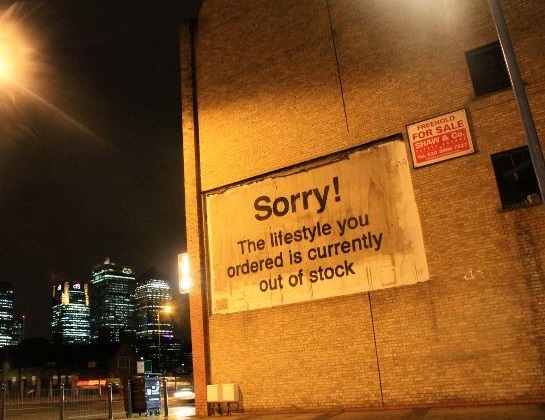
When predictability decays, having a plan is a good thing--but only if the plan is in place now, before it's too late to establish buffers, lifelines and room to maneuver. But since life is what happens while we're making other plans, the backup plan for when the plan B fails and then Plan C also runs aground is adaptability.
Predictability rewards transactional life and places no premium on being pushed to our limits across the entire spectrum of real world life. Unpredictability places a premium on the "muscles" of adaptability and the humility that comes from knowing our limits and the boundaries of our experience.
Predictability transitioning to unpredictability reminds me of Yeats' famed lines:
Turning and turning in the widening gyre
The falcon cannot hear the falconer;
Things fall apart; the centre cannot hold;
Mere anarchy is loosed upon the world,
The blood-dimmed tide is loosed, and everywhere
The ceremony of innocence is drowned;
The best lack all conviction, while the worst
Are full of passionate intensity.