| |
Post-Bubble Exurbia: Flint, Michigan?
(August 5, 2006)
Readers have added a number of scenarios to
Twilight for Exurbia?, which proposed that commute-Hell exurban communities
might suffer near-abandonment in the post-bubble housing decline. The entry included
a link to an aerial photo of a hollowed-out Detroit neighborhood as an example of
what can happen when jobs and people leave an area.
First up is an astonishing description of Flint, MI by correspondent A.L.:
(Note to residents of Flint: this is not a knock on your town; most people just
don't know how devastating it is when the Company leaves a Company Town; I lived
in a Company Town, so I know):
I spent a bit of time in Flint MI and saw your example of hollowed out
neighborhoods first hand.
The overhead view gives no concept of the depth of decay. It's as if the
world ended and you are on a post-apocalyptic anthropological
observation tour. Trees have regrown through what once were houses, and
the undergrowth has filled in the margins of civilized infrastructure.
Here and there one can see signs of structure, the odd driveway, or
fireplace brick. But for the most part it's literally a jungle, filled
with wild animals and the occasional human. There are whole square block
sections that are impassable by automobile, and seem bound to return to
complete wilderness someday.
The law of the jungle applies here, the Flint police department is a
shriveled husk of its former glory. Why bother to patrol the empty
wastelands at all?
My friend who was working for GM Engineering has since been transfered
to Ann Arbor, and it's a veritable wonderland, being a college town an
all. He's ridden the real estate rollercoaster as well, but he's a
fiscally ultraconservative and is happily ensconced in his cheapo 50s
ranch house that he bought 10 years ago.
What housing-related factors can we take away from this account?
How about:
Areas which are heavily dependent on a single industry (in Flint's case, automobiles
manufactured by General Motors) are especially vulnerable to abandonment should
that industry falter.
Which raises an interesting question: what if the primary industry in an area is
housing itself?
Locales with established government-supported institutions such as large universities
will be much less likely to suffer a community-destroying loss of residents.
Another knowledgeable reader suggested that people might well stay in their homes regardless
of foreclosure proceedings:
What you and your other reader are assuming is that persons foreclosed upon will behave
rationally and give up the asset. I would submit to you that for owner occupied properties,
a large proportion of foreclosed owners will remain as squatters. There will be very
little appetite in the U.S. for evening news photos of large scale forced evictions, and as
banks are faced with increasing inventories of foreclosed properties in "management"
little interest in actually evicting the ex-owners.
Where are those foreclosed owners going to go? Unless there is a major change in how
apartments and most landlords of SFH (single family home) make decisions on tenant selection, few will take
the risk of renting to someone with a recent foreclosure on their credit history. In
this scenario, where traditional re-housing in rented accommodations is
difficult/expensive/impossible, it's move home to your parents (or other relatives),
a Hooverville, or stay in place and wait for the forced eviction. My guess is most
will choose to squat, particularly as banks get distracted by the sheer volume of foreclosed
properties.
Overall this additional stickiness will prohibit the price curve of housing from tracking
the price curve of liquid, unsticky assets as your thesis asserts. It would also argue
against wholesale "suburb death" for strictly reasons of foreclosures of occupied properties.
This reader brings up a number of important issues. Sheriffs forcibly evicting former
homeowners from their houses may well have unforeseen political consequences. But I also
see five other factors in this scenario:
Areas with large numbers of "speculator/flipper" property owners may not have enough
actual residents to create a neighborhood people want to stay in.
Banks may try to escape the "squatter" problem by selling distressed properties for
peanuts to private investors, who will then take individual, less-visible/newsworthy
actions against the former owners/current squatters: quiet evictions, cash pay-offs to move,
negotiations for some kind of rent, etc.
People's decision to move or stay put will largely hinge on their income. If they have
lost their job or the majority of their income, they will have no choice but to move in
with family or friends or a Hooverville (encampment of the unemployed, named after the
President who waited for "market forces" to resolve the Great Depression.)
The reason? Even if they're squatting, they will need money for food, gasoline, heat, etc.
So in other words, if a two-worker household loses one job, squatting makes financial
sense. But if both wage earners lose their jobs, or a single-earner household loses its sole
source of income, people will have every incentive to move in with family once their
unemployment runs out.
In a recessionary environment, landlords may well be less picky about the credit history
of tenants. I suspect that many landlords will be more interested in prospective tenants'
income than in their credit history--especially if said landlord is sitting on lots of
vacant units. Some landlords may well be counting on rents to stave off
their own bankruptcy/foreclosure, and that will also make them less sensitive to issues
such as credit histories. Lastly, experienced landlords can tell the difference between
evictions for non-payment (a bad risk) and bankruptcy/foreclosure (maybe a risk, but
maybe not; in a recession, lots of people lose their homes and that doesn't necessarily
mean they will be bad tenants.)
This brings up another question: if thousands of single-family houses are sold at
auction, then how much money will the new owner have to charge in rent
to pay the mortgage (if any), property taxes, maintenance, etc.? If a house which once sold
for $300,000 is sold at auction for $100,000, the new owner may well be happy to collect
a relatively modest amount of rent because his/her expenses are so low.
(Note that for
desperate lenders sagging under huge numbers of non-performing loans, a $100,000 cash offer
is far more attractive than a $200,000 offer with $20,000 down and a new loan of $180,000.
The reason is that the lender's cash reserves against bad debt--the reserves which are
mandated by regulatory agencies--will be a negative number, so cash is what they need, not
a new loan.)
The decision to squat or leave may well depend on the shoddiness of the construction and
the safety of the neighborhood. If hastily built subdivisions start falling
apart (leaky roofs, leaky, mildew-infested plumbing, electrical wiring issues, etc.), people
may prefer the dry safety of their in-law's garage. Also, if neighborhoods attract
unsavory types of squatters as well as the recently dispossessed, the neighborhood could
quickly become an unsafe, dangerous haven for the predatory wolves in our society.
At that point, decent people will move out, regardless of any other issue.
Astute reader D.F. provided another answer to the question,
"where might oversupply lead to outright abandonment of recently built homes?"
and a chart to back up this scenario:
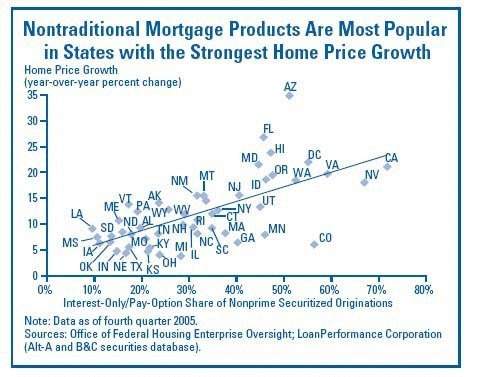
I predict that we will see entire neighborhoods, even in major metropolitan areas, that
were built near the end of the housing bubble (2004-2006), where the majority of people
put down pre-construction deposits and took out interest-only or ARMs loans and put very
little, if any, $$$$ down. I would look at Florida (Miami, Ft. Lauderdale, Tampa),
California, DC, Vegas, Phoenix, Seattle, etc.
Thank you, readers, for these thought-provoking comments on an important subject.
For more on this subject and a wide array of other topics, please visit
my weblog.
copyright © 2006 Charles Hugh Smith. All rights reserved in all media.
I would be honored if you linked this wEssay to your site, or printed a copy for your own use.
|
|

