Automating Our Dependence Will Cripple Us
April 9, 2026
The rush to monetize automation / AI is self-liquidating.
Thank you, Jeff R. ($70), for your monumentally generous subscription
to this site -- I am greatly honored by your support and readership.
Thank you, Bryan J. ($75.60), for your marvelously generous subscription
to this site -- I am greatly honored by your support and readership.
Thank you, Savvy Southerner ($70) for your superbly generous subscription
to this site -- I am greatly honored by your support and readership.
Thank you, Jim P. ($70) for your fantastically generous subscription
to this site -- I am greatly honored by your support and readership.
Dependence is easy but crippling. When we're children or advanced in age, we're dependent on adults for our care. This is the normal flow of human life. But when we're dependent as adults, it cripples us, for it removes the pressure to acquire problem-solving skills that strengthen our facility with both processes and results.
In my post on
The Inevitability of the AI Depression, I noted the distinction between process-based work and results-based work, as standardized processes are easily automated, while generating results that can be tested / verified is much more difficult, as a standardized process might not suffice.
Problem-solving demands integrating both process and results, as being able to repeat the desired results requires assembling a process which is organized enough to generate the desired results but flexible enough to deal with novel problems.
This is the shadowy realm of experiential knowledge, the intuitive tacit knowledge that can only be gained by experience. We can attempt to distill this knowledge down to rules of thumb, i.e. heuristics, but when we turn these heuristics into algorithms, we're converting right-hemisphere integrative thinking into formal rational processes--left-hemisphere thinking. This conversion loses the essential nature of tacit / intuitive problem-solving.
When the State or parents protect adults from the pressure of problem-solve and the consequences of failure, this protection has a price: the adult has no opportunity or pressure to develop the self-confidence that can only be gained by enduring--and learning from--failure, and the uneven, no-guarantees process of experimentation and effort of problem-solving.
The adult learns not how to be independent; they learn to fail so demonstrably that they will be rescued once again.
Failure is stressful--in today's terminology, traumatic. But failure is the source of pressure to problem-solve. If some entity solves all our problems, in effect automating processes so we don't have to learn them and delivering results that we didn't have to figure out how to generate, then we learn nothing that contributes to our experiential knowledge, self-reliance or self-confidence.
Having processes and results automated cripples us: we know virtually nothing because we were never forced by problems / failure to develop the self-discipline, ruggedness, self-awareness and hard thinking demanded to endure failure and keep trying new approaches until we solve the problem at hand.
The harder the problem, the harder the process of solving it, the more we struggle and endure, the more we learn. Failure, doubt, anxiety and suffering are the crucible in which we gain experiential problem-solving skills which bolster our self-confidence and generate skills that can be applied to future problems.
The key to problem-solving is not just learning from the experience of failure, but the experience of joy from finding a solution and the rarely described joys of developing flexible skills and processes--the key word here being flexible.
This brings us to the automation of processes and results via artificial intelligence (AI). The basic idea here is we no longer have to learn the tediously acquired deep-knowledge of how things work, as AI does all this for us.
And we no longer have to learn to triage tasks--eliminate make-work / BS work / low-productivity processes, we simply assign our AI agents to perform all that low-value work and pat ourselves on the back for "optimizing workflows."
As for getting results, we simply prompt AI agents to generate the desired output. And since we don't actually know how to generate these results ourselves, we have to trust that the AI agent is 1) telling the truth, which is itself a problem we cannot solve, and 2) that the result isn't a hallucination or falsity generated by the homogenization of the AI's knowledge base and programming.
There is no pressure now to tediously acquire deep knowledge such as learning a foreign language or learning how to play a musical instrument proficiently, as AI translates everything and can compose music (and everything else) via prompts. There's no longer any need to learn how to write well, as AI does this for us.
All these automated processes and results are homogenized, as AI eliminates the rough edges of variability as reducing the probabilities of a result that passes the tests of accuracy.
This is why studies have found that human users of AI have homogenized thought processes even after they stop using AI.
What's lost in automating processes and results is far more profound than the mainstream can grasp. We lose the ability to think deeply, and this cripples our capacity to develop real problem-solving skills. And since it removes the pressure of having to learn difficult skills and the pressures generated by failure, we no longer have any incentive / selective pressure to learn experiential, tacit knowledge.
Writing isn't just stringing together words in a format that passes auto-correct spelling and grammar rules. Writing is the process of deep thinking.
Learning a foreign language isn't just something that facilitates being a tourist. It's a process of learning new ways of contextualizing and organizing the world, and this too is a process of deep thinking.
Here is an example of what I'm describing. This is Fragment 54 from the ancient Greek philosopher Heraclitus. Notice the range of translations into English.
"Latent structure is master of obvious structure." (quoted by Philip K. Dick)
"The unseen design of things is more harmonious than the seen." Guy Davenport
"The hidden attunement is better than the obvious one." Charles H. Kahn
"Harmony which does not appear clearly is superior to that which is clear and apparent."
"Apparent, hidden. more powerful, more desirable."
"Hidden structure is more powerful than visible structure."
I do not know the Greek language but I studied a text that placed the original Greek side-by-side with the English translation and exegesis, so I could discern the sources of the many translations.
I've found the same is true of the many translations of the Tao Te Ching. I do not know Chinese, but I am familiar with the construction and ambiguities of key ideograms. I've read many translations but prefer that of my professor, Chang Chung-yuan: Tao: A New Way of Thinking.
Here is an excerpt from Chapter 41:
Understand Tao as if you did not understand it.
Enter into Tao as if you were leaving it.
I've formally studied French and Japanese, and am not fluent in either, but I learned enough to grasp how social structures are reflected in the language itself.
None of this is visible in an AI translation. It's too easy and so we become dependent not just for the translation but in the loss of the ability to understand more than the superficial conversion.
In music, composing is now easy: just prompt AI. But in becoming dependent on AI we can never experience the frustrations of trying different chord progressions and working out a new melody, or experience the physical sonic joy of strumming the "magic E chord" (7th fret on the guitar).
I spent hours working out a double-lead for guitar that lasts all of nine seconds on the recording. The process was painstaking but fun, in the way that only painstaking experimentation can be fun. You learn by stretching yourself, not by repeating what you already know or having AI do it for you.
I only have my own life experiences as examples, and so these may not be great examples but they're all I can vouch for because I lived them.
Just the other day I was working on an old structure constructed of steel pipes. One of the joints was rusted and needed to be strengthened. The conventional approach would be to replace the whole thing, at significant expense, or replace (at great expense of labor) the rusting lengths and connectors. Neither was worth the time or money in this situation, so I rummaged through the workshop and found a steel plate that's used to cover copper piping running inside stud walls so drywall nails or screws don't puncture the water lines.
I bent the plate into a curve using a few tricks and drilled holes through the steel pipe and connected the plate with through-bolts left over from another project. Is it a thing of beauty? Not by a long shot. Does it do the job at zero cost and a few minutes of my time? Absolutely. Did it solve the problem with minimal investment? Yes.
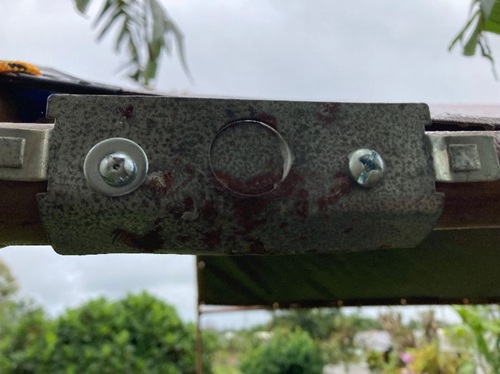
The problem wasn't a deficiency of beauty. The problem was strengthening a weak connection and time pressure (daylight ending). Quick-and-dirty was the optimal solution.
I doubt a robot could have replaced my processes. They're too extemporaneous, too contingent, too unpredictable (using what's laying around, etc.) and require multiple tactile skills of applying just the right amount of force, but not too much. They're based on 53 years of experience with tools, metal, connectors, and the physical knowingness that can only be gained from long, wide-ranging experience. Everyone with similar experience knows what I mean.
Growing food isn't easy. We look at mechanized equipment guided by AI and we think it's easy, but it is intrinsically difficult due to Nature's variability. Learning how to grow food takes a high tolerance for failure and experimentation, careful observation and the discipline to record what was tried and how it fared. I use six kinds of fertilizer, in various combinations depending on the tree / plant. Others have developed their own mixes and stratagems depending on their terroir and experiences.
Once again, there is no algorithmic shortcut. The only process that yields problem-solving on the fly is experiential.
People occasionally suggest I "monetize" our produce, selling it at a farmer's market, etc. This misses the point via a fatally flawed reduction of everything to money. The point is self-reliance, the acquisition of priceless skills and experience, and the sharing of our produce with others to strengthen a social network. Selling our produce would be a catastrophic waste of a precious resource. Not everything of value can be priced in money.
When we were building our house in our 20s, with no loan and minimal savings / income, we moved into the shell with Visqueen (sheet plastic) over the window openings as soon as we had a working tub and toilet. A two-burner camp stove was the kitchen. We did the dishes in the tub. Under pressure, you improvise. It wasn't that hard; we were sheltered from the weather and had everything we needed.
Many people misunderstand athletics. They think it's about talent or winning. It's actually about training, not to hit some metric (weight lifted, miles run, etc.) but integrated physicality: agility, strength, speed, endurance and the capacity to endure while avoiding needless injury brought on by prideful excess.
Despite a complete lack of talent, I played team basketball for five years and one season of football. I learned about training, self-discipline, unit cohesion and much more. Training is tedious and maintaining agility, strength, speed, endurance and the capacity to endure is demanding. But once again, there is no substitute for experience.
(If you want a metric, choose one that reflects overall health: the triglycerides-HDL cholesterol ratio: triglycerides divided by HDL. Under 2 is good; even lower is better. Mine is 74/61 probably because I work stupidly hard physically instead of buying a robot.)
When everything is given to you or done for you, you learn nothing, have nothing to be proud of and no experience of the joys of hardship met and sacrifices made that paid off. And if they didn't pay off, you learned something valuable that could be usefully applied later.
What looks easy when watching a cooking video is tricky in real life. Consider a basic skill like making a roux--cooking flour in butter. It's easy to undercook it or burn it. You really only learn by making both mistakes.
So buy food out and learn nothing or learn to cook the hard way, which is the only way.
This is the fatal consequence of becoming dependent on automation / AI to "optimize everything." We're actually optimizing failure.
The fatal consequences are scale-invariant. New research suggests the vast, immensely successful Khmer civilization in southeast Asia succumbed not just to environmental changes (drought) but to the decay / loss of the social / institutional know-how needed to maintain the complex system of waterways and irrigation that enabled food production at scale.
No human remains were found in the abandoned cities. There were no mass die-offs; the residents just left. Since they retained the basic skills needed to make a living off the land, life went on.
As our horrendously complex systems become dependent on automation / AI, without being aware of it we're generating dependencies that carry grave risks: once the number of humans who truly understand how to build systems from scratch or reconfigure them on the fly dwindle, when novel conditions cause the automated systems to fail, recovery will be out of reach.
Right now, this sounds farfetched because there are still enough people around who have deep experiential knowledge and tacit problem-solving skills. But since these skills cannot truly be taught, they must be learned the hard way, by tedious experience of failure and experimentation, then once those people retire, the entire civilization is vulnerable to cascading failure.
This is why I say that the rush to monetize automation / AI is self-liquidating: in optimizing both low-value workflows and essential systems, we're becoming fatally dependent on systems we no longer have the experience to fix on our own.
This post was first distributed to paid subscribers; how to subscribe to OTM. Thank you for supporting my work.
My book Investing In Revolution is available at a 10% discount ($18 for the paperback, $24 for the hardcover and $8.95 for the ebook edition).
Introduction (free)
Check out my updated Books and Films.
Become
a $3/month patron of my work via patreon.com
Subscribe to my Substack for free
NOTE: Contributions/subscriptions are acknowledged in the order received. Your name and email
remain confidential and will not be given to any other individual, company or agency.