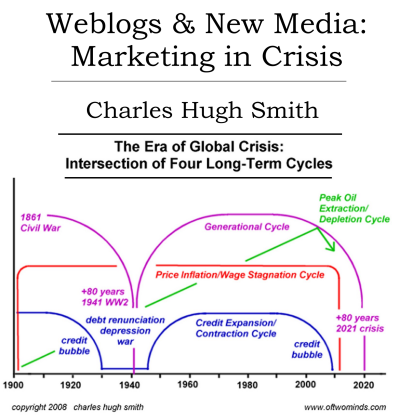
1. "Standard Model" marketing is in crisis,
as it is mal-adapted to the global era of extended turmoil we are entering.
2. This book is a primer on how to build new, enduring ties to customers and stakeholders
in the coming era of crisis by leveraging the largely
misunderstood power of weblogs and New Media--what I call "The Power Yet to Come (TM)."
For better or for worse-and we all have some choice as to which of the two
we will experience-the world is entering an extended era of disruption caused by
the intersection of four mutually reinforcing cycles:
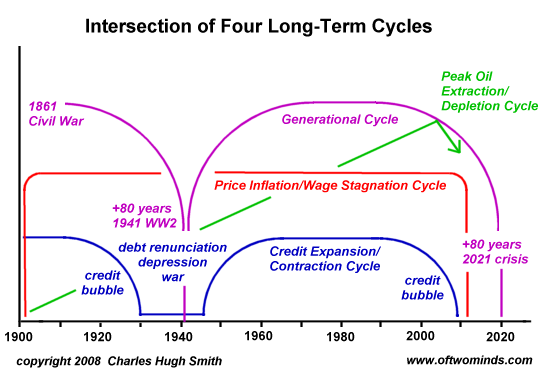
1. Peak oil, or the depletion cycle/end-game of the global economy's complete
dependence on inexpensive, readily available petroleum/fossil fuels.
2. The cycle of credit expansion and contraction (approximately 60-70 years), which is now
beginning the transition from unsustainable credit expansion (bubble) to renunciation
of debt (credit collapse) and global depression.
3. The generational cycle (4 generations or approximately 80 years) of American
history which leads to nation-changing social, political and economic upheaval.
(The American Revolution: 1781 +80 years = Civil War, 1861
+80 years = 1941, World War II + 80 years = 2021)
4. The 100+ year cycle of price inflation and stagnation of wages' purchasing-power
which began around 1901
is now reaching the final stage of widespread turmoil, shortages, famine,
war, conflict and crisis.
 Within any complex system--and human culture and the global economy are certainly
both complex systems--there are leverage points of varying strength.
Within any complex system--and human culture and the global economy are certainly
both complex systems--there are leverage points of varying strength.
The key leverage points which are easiest to change are:
1. Add an information feedback loop
2. Change a goal
The most powerful leverage point, and the one most culturally and institutionally
resistant to change, is a paradigm or worldview (weltanschauung).
As that is the most powerful leverage point, it is the one I am pursuing here.
A Note on Method and Language
As is already abundantly clear, I do not come from a marketing background or
worldview, though as an entrepreneur I have marketed myself, my ideas, and my
products and services for decades. As an entrepreneur, I am well aware of the
First Principle of capitalism, which is creative destruction. No firm or
institution is too big to fail, and many become too unwieldy to survive a rapidly
evolving world or paradigm. Small firms are not guaranteed survival, either;
every market and provider will have to adapt successfully or face destruction.
Since I have been a student of powerful ideas for 40 years--a notion both obscured
and described by the word philosophy--I naturally turn to ideas and cycles which
have withstood the test of time and thus retain predictive or explanatory powers
beyond the facile "trends du jour" trotted out in the popular business media.
Most advertising and marketing are similar, much as automobiles have become very similar
in shape, design and features. The reason is that they are all drawn from the same well
of ideas, the same worldview and the same context/training.
I draw upon a different well.
Having confessed my weakness for philosophy, proceed at your own risk.
These ideas are drawn both from history/philosophy and from my own experience in
building a fast-growing and steadily expanding
audience for my weblog, and from my study of marketing, weblogs and New Media. Expertise
in these fields flows from Emerson's phrase: "Do the thing and you will have the
power." That is, the experts are the ones who have taken their weblog/New Media
audiences from near-zero to the hundreds of thousands/millions and who have created
new bonds of loyalty with customers/stakeholders. I have attempted to distill the
concepts common to enduringly successful (i.e. not a supernova which burns brightly
for a moment and then recedes to a dark husk) New Media sites.
The following list of characteristics is not exhaustive; the field is too new and
dynamic for anyone to claim a definitive understanding or account. I believe an understanding of
these ideas and characteristics will help anyone whose financial survival depends on
a business or organization's successful transformation in the era ahead.
Those with no stake will still gain from the intellectual exercise of
disputing/contesting every concept and critique.
The four reinforcing trends will unleash unprecedented creative destruction.
Together, they form a bottleneck through which many firms, institutions and organizations
will fail to pass.
The process of Creative Destruction is the essential fact about capitalism.
Every business strategy acquires its true significance only against the
background of that process and within the situation created by it.
Joseph Schumpeter
The Standard Model of advertising and marketing will produce fewer and fewer results
as it fails to map the profound demographic, energy, cultural, technological
and financial cycles which will dominate life and business for decades to come.
But in capitalist reality as distinguished from its textbook picture, it is not that
kind of (price) competition which counts but the competition from the new commodity, the new
technology, the new source of supply, the new type of organization--competition which
commands a decisive cost or quality
advantage and which strikes not at the margins of the profits and the outputs of the
existing firms but at their foundations and their very lives.
The Web is widely understood to be that competitive advantage, but the nature of its
marketing and relationship-building advantages have been masked by outdated paradigms
of structure, advertising, marketing and CRM (customer relationship management).
Weblogs and New Media are perceived as part of that competitive advantage, but without a conceptual
understanding, their advantages are lost in the slapdash miasma of websites, wikis,
and
other web technologies that constitute "Internet strategies" for most firms/organizations.
Understanding and implementing those advantages is the heart of "The Power Yet To Come" (TM).
The wrenching demographic, financial and cultural changes which will dominate the decades
ahead have long been visible to those with a grasp of history, but they are just now
entering public awareness. Every firm's prosperity--and eventually, its survival--
depends on adapting forcefully and insightfully to these profoundly disruptive global
cycles.
Competitive Advantage Begins with Insight
"Solutions" are predetermined by how the "problem" is framed. If the "problem" is improperly
framed, the "solution" will lead us away from addressing the actual problem.
Problems cannot always be "solved" with the same level of thinking that framed them.
Identifying competitive advantages in a hyper-competitive
world which is entering an extended era of turmoil must begin with an understanding of the
operant contexts of our time and the two models of history which illuminate them.
History can either be viewed as proceeding along an innate vector (entelechy)
toward a goal (telos) or
as a cyclical process which "echoes" previous cycles.
There is abundant, irrefutable evidence that the global economy is facing an unprecedented
confluence of crises/challenges which will threaten the survival of
institutions, corporations and organizations. "Business as usual" will doom those
clinging to the status quo to the ash-heap of history.
Ideas are not trends, and trends are not entelechies.
The idea which offers the
best account/map of an era's causal conditions will endure until a new
paradigm/account takes root which offers a more insightful, more accurately
predictive worldview/mapping. An enduring idea totalizes history and current
experience, making sense of events and causes which previous ideas/models did not
adequately describe or explicate.
A trend is either an ephemeral cultural fad or a statistical construct; as the causal
factors lie elsewhere, a trend's predictive value is limited to statistical probabilities.
But probability is not causation, and the entelechies which are unfolding are causal;
thus, predicting behavior based on recent trends is a superficial exercise.
Unlike a trend, an entelechy generates its own future from within itself; the seeds of its
future course (or end-state, goal, telos) are already implicit in its seed/initial state.
For example, the discovery of oil already contained its future depletion; the
end-state and path was defined by petroleum's nature and its discovery in an industrializing
era and nation, not by statistical probabilities or trends-du-jour.
Marketing software which seeks to predict consumers' future purchases or interests from
data-mining/algorithmic extrapolations of past purchases is thus a statistical exercise
in trend-seeking.
Without an idea that accounts for the consumer's future behavior--an idea which maps
the inner logic of the consumers' priorities and the worldview which shaped them--
or an entelechy that
dominates the era's worldview,
the statistical/software construct is fundamentally powerless as a causal guide.
Statistically, there is a slim chance that you might strike oil in your backyard. But
geologically, there is no causal evidence that oil could have formed there by any known
processes. Thus it is not just statistical bad luck no major oil fields have been
found since the early 1970s; geologically, all the possible areas which possess the
specific conditions for the accumulation of oil have been explored.
Thus there may well be a statistical basis to believe in huge future oil finds, and the
trend toward higher proven reserves may suggest ever-larger discoveries of oil lie ahead,
but the causal factors of geology, chemistry and locale (the petroleum entelechy)
are traveling down a vector with only one end-state: depletion.
Weblogs & New Media: Marketing in Crisis (73 pages, $10.99)
Marketing in Crisis (Kindle edition) ($5.00)
A note of thanks to those who buy the book or eBook: As an independent writer,
book sales are a substantial part of my income. I receive no funding from
a university, trust fund, hedge fund, think-tank or government agency. I self-publish my
books as a financial necessity, as the small royalties (5% to 7.5% of the retail price)
paid by publishers cannot support me during the long months it takes to write a book. Your purchase
makes it possible for me to continue sharing ideas on the blog and in my books. Thank you.
copyright © 2008-2012 Charles Hugh Smith. All rights reserved in all media.
No reproductions in any media without written permission.